
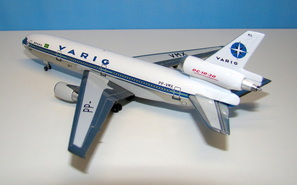
Following on from Part 1 VARIG by the mid-1960s was Brazil's primary international airline, but in getting to this position, through its acqusition of its competitors, it sure had gained a varied fleet. VARIG had chosen the 707-441 as its primary long-haul jet type but REAL and Panair do Brasil had not and that led to multiple jet types in service. Eventually however VARIG would in the 1970s be able to clean things up a bit and standardise on McDonnell Douglas' DC-10 trijet.
0 Comments
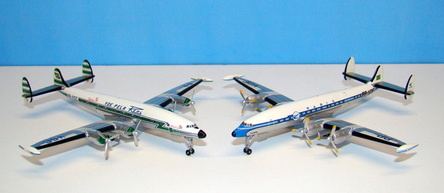
Sociedade Anônima Empresa de Viação Aérea Rio-Grandense – VARIG was founded in May 1927 by a German immigrant who was also an ex-WW1 pilot. The influence of WW2 and Brazil's eventual allied status put an end to any German involvement but the airline's development progressed well postwar with the addition of DC-3s and C-46s. In 1949 it gained permission to begin international services to the USA, though services did not begin until 2 August 1955 after the delivery of 3 L-1049G Super Constellations. Two years earlier international services to Buenos Aires had begun with C-46s.
REAL (Redes Estaduais Aéreas Limitadas) was formed by two ex-TACA pilots in 1945 starting operations with 3 DC-3s. Several smaller airlines were purchased in the and in 1951 international routes began. 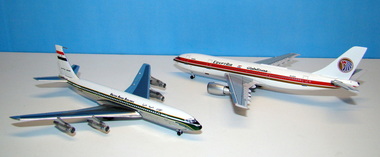 Between 1958 and 1961 there was short-lived political union of Egypt and Syria (see United Arab Republic - Wikipedia, the free encyclopedia) leading to the Egyptian national airline Misrair becoming United Arab Airlines (UAA). The union was more a takeover of Syria by Egypt partly as a way of crushing Communism in Syria but also as a stepping stone to a possible pan-arabic state. The union of the two countries collapsed on September 28, 1961, however Egypt remained officially known as the United Arab Republic until 1971 so UAA also kept its name.
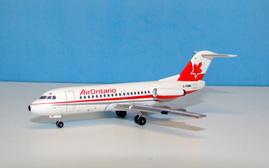
Air Ontario was formed in 1981 when Great Lakes Airlines was renamed. Its growth during the 1980s would see its merger with Austin Airways and affiliation with Air Canada, however even though it was a successful commuter, which would go on to form one of the central components of Air Canada Jazz, not all its moves paid off. Certainly the purchase of a pair of F28 Fellowships would not be the success that its first pure jet service hoped for and in fact would end in tragedy.
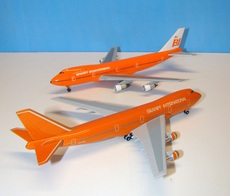 Braniff’s first 747 was nicknamed ‘The Great Pumpkin’ or ‘Big Orange’ due to its bright orange scheme and was decked out internally with the finest leather seats and furnishings. The cabin was split into five rooms with its own colours and lounge space and was branded the 747 Braniff Palace ‘The Most Exclusive Address in the Sky’. Revenue service began on 14th January 1971 between Dallas and Honolulu. For the next seven years the airline’s sole 747 (a second was cancelled) operated the daily Hawaii service recording record utilisation rates for the type.
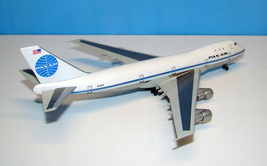 Rarely has a single aircraft been so famous and at the same time so notorious as the Pan Am 747-121 N736PA 'Clipper Victor'. No other airline has done so much to change long-haul aviation as Pan Am however in the swansong of his career Juan Trippe bit off more than his airline could chew with the Jumbo. In April 1966 Pan Am placed an order for twenty five 747s at a cost of the staggering sum of $525 million. The huge debt this created for Pan Am was something that exposed the airline when the expected growth in passenger numbers failed to arise and the Oil Crisis struck. And so began the long decline of the world's greatest international airline.
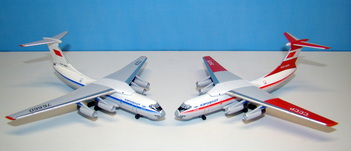
The Soviet-era produced vast numbers of aircraft but very few of them have garnered much respect in the Western world. One that definitely has is the Ilyushin IL-76, although admittedly it is a military type first and a civilian aircraft second. NATO gave it the codename 'Candid' and though far from a looker it has proven its worth over the years as a very effective all purpose transport aircraft - almost like a pure-jet Hercules. The type first flew in March 1971 and was designed as an Antonov AN-12 replacement capable of operating into unprepared airstrips in inhospitable regions and weather.
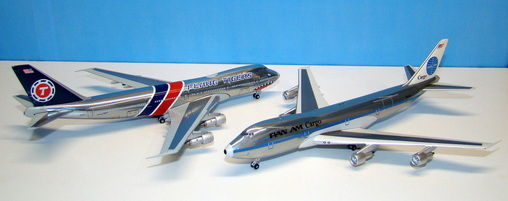 During the 1960s and 70s Flying Tigers was the largest all cargo airline in the world and they were responsible for a number of firsts. On August 29, 1973 Tigers were the launch customer for the 747 freighter.
The airlines had been over-optimistic about growth opportunities for the 1970s and had binged on 747s, which they struggled to fill even before the Oil Crisis arrived. These factors led to several airlines trying to slim down their 747 fleets and motivated Boeing to look at alternative uses for the type. Several ex-TWA examples found their way to the Iranian Air Force and Boeing also began looking at freighter conversions. 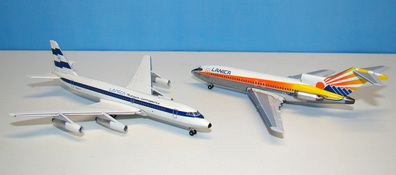 Líneas Aéreas de Nicaragua, operating as LANICA, was the national airline of Nicaragua from 1945 until 31 August 1981. Its history is indelibly caught up with that of the Somoza family's dictatorship, which ruled the country from 1936-1974.
Despite Somoza Garcia's thoroughly undemocratic actions after winning the 1936 Presidential elections his opportunistic support of the Allied war effort during WW2 not only enabled him to build up an enormous fortune but also to gain the interest of Pan Am which setup LANICA as a subsidiary with PA holding a 40% share. Initially the Somoza's obvious corruption and suppression of freedoms earned the ire of the US but the country's anti-communist stance and some deft politiking enabled Somoza to keep the US on side and LANICA to grow. 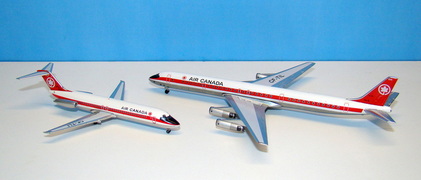 Trans Canada Airlines was one of only three airlines that ordered the DC-8-40 with Rolls Royce Conway engines (the others were Alitalia and Canadian Pacific). They entered service on transcontinental routes in April 1 1960 followed by international sectors on June 1.
Four DC-8-41s (CF-TJA-D), four DC-8-42s (CF-TJE-H) and three DC-8-43s (CF-TJJ-TJK) arrived up to December 16 1961. The series 40s with their older engines were the first DC-8s to leave the fleet being withdrawn from September 1975 to June 1979. 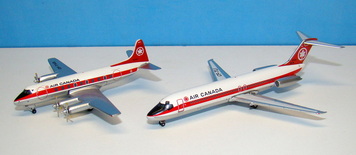 As discussed in the Trans-Canada history Air Canada officially came into existence on January 1 1965, though the Queen had actually travelled on the first Air Canada liveried aircraft in 1964. That new livery introduced the maple leaf on the tail, black titles and a red cheatline with black anti-glare sloping down from the cockpit to the nose. It was designed by the firm Stewart, Morrison & Roberts.
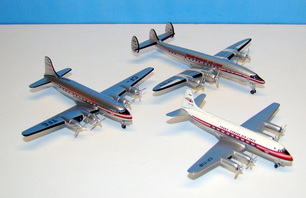 Canada's major two airlines both sprung from railroad companies at quite a late stage, when it was clear war was approaching and aviation was growing rapidly in the neighbouring USA. Trans Canada Airlines was started by the Crown Corporation Canadian National Railways (CNR) in 1937. From 1943-1947 TCA operated the Canadian Government Trans-Atlantic Air Service to provide trans-Atlantic military passenger and postal delivery service using Avro Lancastrian (modified Avro Lancaster) aircraft. Postwar the service became a civilian route.
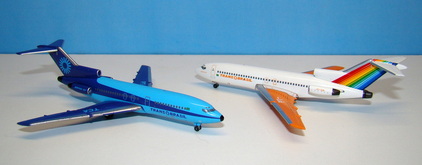 Brasil has always had an interesting and colourful civil scene and like many South American nations its aviation history is now a graveyard of great names as airlines have been mismanaged and found themselves unable to compete with startups in the deregulated era.
So Varig, VASP, Transbrasil and Cruzeiro Do Sul now find themselves consigned to the history book and replaced by TAM, Gol, Azul and others. Transbrasil must surely be the most colourful of the Brasilian airlines of the past... 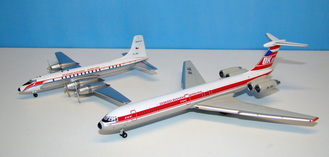
Czechoslovakia like several European nations was caught in a tug of war between Superpowers in the immediate postwar era and unfortunately for them after years of Nazi domination traded one form of tyranny for another when the Iron Curtain rose up and they were on the wrong side of it.
The air network, which had flourished in the immediate postwar era, was curtailed in 1948 but despite this the reformed CSA Československé státní aerolinie (Czechoslovak State Airlines) was one of the more successful and progressive of the Eastern Bloc airlines. 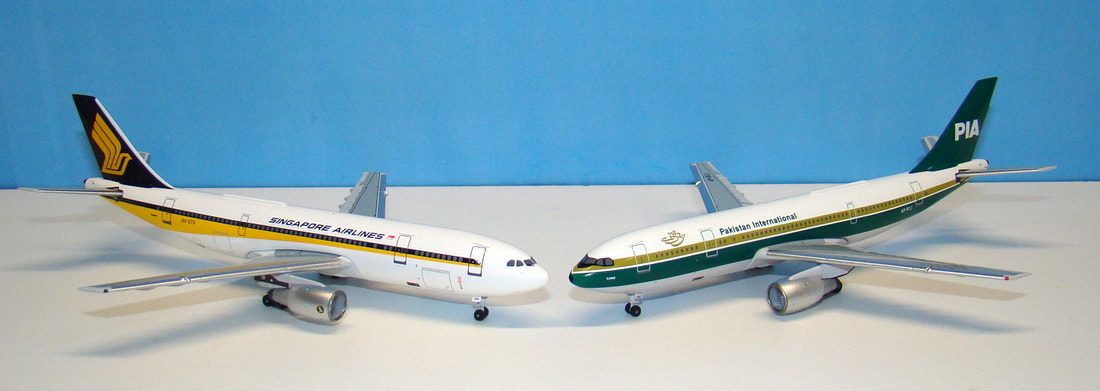 Aeroclassics recently released SIA and PIA Airbus A300B4s and as with my Western/Air Pacific DC-10s it turns out they are the same airframe. Singapore Airlines was renowned during the 1980s for operating aircraft for only very short periods prior to selling them on.
|
AuthorI'm Richard Stretton: a fan of classic airliners and airlines who enjoys exploring their history through my collection of die-cast airliners. If you enjoy the site please donate whatever you can to help keep it running: Archives
July 2024
Categories
All
|
 RSS Feed